
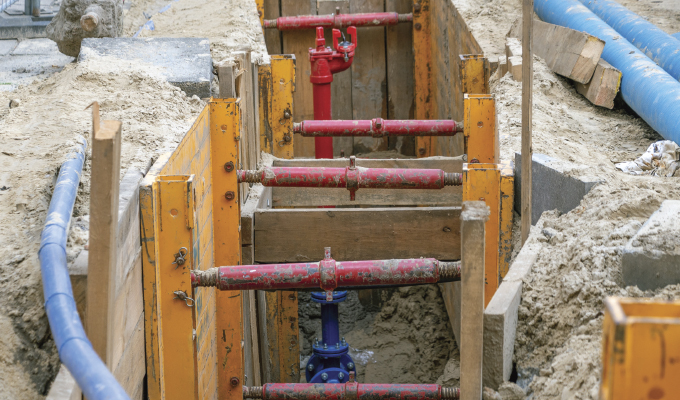
Companies involved in trenching and excavation realize true savings through the use of proper trench support. We use the word “proper” because, too often, a decision is made to use some form of trench support that is not designed or rated for the work a contractor is doing.
Our bottom line is simple: Proper trench support methods and equipment save you money. In fact, the year-end savings will exceed the cost of the right equipment many times over.
JOB PLANNING = SAFETY AND COST SAVINGS
Picking the right equipment for a particular job saves you money. Excavation work will throw you a lot of curveballs with water conditions, unmarked utilities, and changing soil conditions. If the job is well-defined, it’s simple: Pick equipment that will do the job fast and safely. If you anticipate some “curveballs,” though, pick equipment that is as variable as possible. Some options could include hydraulic vertical shores with various length cylinder extensions. A modular aluminum trench shielding system—often called Build-A-Box—can be figured into two-, three-, or four-sided configurations, offering maximum on-the-spot shoring solution flexibility. Have the additional equipment on the job site so your crew can respond quickly. How much will it cost for your crew to wait hours—or more—for the right equipment?
AVOID COSTLY REPAIRS
The cost of repairing existing utility lines or infrastructure damage due to improper trench support can be astronomical. Rupture a gas line, cut a computer trunk line, or undermine an adjacent building… How much do you think that will cost your company?
REDUCE SOIL REMOVAL AND REPLACEMENT COSTS
Is your project in a current roadway? What do the specifications for the project say about backfill? Can you store your excavated soil on the road or on the job site? Most projects call for “select backfill” or require you to keep the roadway clear or to store excavated soil off site. Select material costs a lot of money, and off-site storage increases trucking costs. A 10-foot deep, 4-foot-wide trench will be 4.7 times larger if sloped in Type-C soil than the same trench will be if supported with shoring or shielding. A 10-foot deep, 4-foot-wide trench will be 4.7 times larger if sloped properly in Type-C soil than the same trench will be if supported with shoring or shielding. A 10-foot square, 10-foot deep pit, when sloped in Type-C, is more than seven times larger than one shored or shielded.How much will all that extra soil you removed cost you? Is that in the project budget?
REDUCE WORKER’S COMPENSATION CLAIMS
Worker’s compensation premiums are a big cost to your business. Rates are established for your industry, but what you pay is determined by your three-year “experience modifier.” If yours is a safe company, without a history of accidents, your “modifier” will be below 1.0—and that will be multiplied against the industry rate, so you pay a lower total premium. If you have a history of accidents, however, your “modifier” will be above 1.0 and you will pay more than the industry rate. That means, when you bid against your competition the difference could be 10-20 percent, and you might not be the “low bidder.”
AVOID DAMAGE TO ADJACENT PROPERTY
Are you responsible for site restoration? If so, what do extra asphalt, curbing, and sidewalks cost? The right excavation shoring means those costs will be minimized. Will you excavate adjacent to a bridge or a building with a “spread footing?” If you excavate your sub-grade below the elevation of those footings, you might undermine the foundation. How much do you think fixing the foundation will cost? (And wait till you see your next insurance premium!)
REDUCE DISPOSAL LIABILITIES
If you pay for site restoration, or if it is covered in the specifications, you will need to dispose of concrete curbs, sidewalks, and asphalt. Keeping your excavation “tight” will save you excavation time, trucking costs, and disposal fees.
AVOID HEAVY FINES AND LEGAL PROBLEMS
OSHA fines start at $14,502 per violation. If OSHA determines that your company has “Willful or Repeated” violations, the fine goes to $145,027 per violation. No one wants to think about a death on your site. Yet the tragedy of a worker’s death can also mean the end of your company—and jail time. How can that be worth a lack of planning or proper equipment for the excavation on your job site?
NAXSA members have decades of experience in the business of excavation support. We have completed hundreds of thousands of projects, big and small. We know that promoting safety is more than words and feelings. It saves the lives of our customers—and helps you be more successful in your business.
Consider these points. We believe you’ll see, without a doubt, the wisdom of working better.
for more information
The North American Excavation Shoring Association (NAXSA) was created to promote the safe and efficient use of excavation shoring practices. For more, visit www.naxsa.org.