

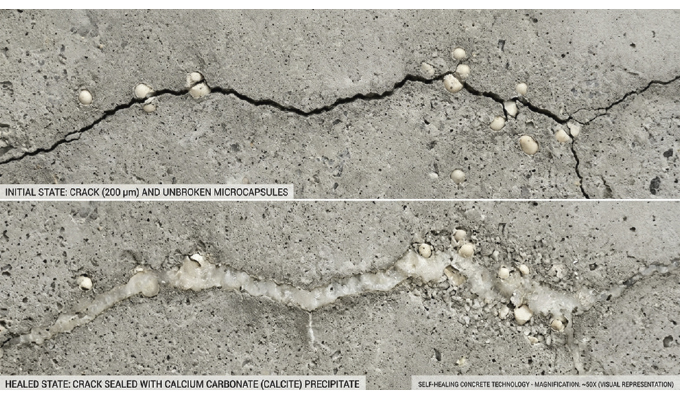
Every owner and facility manager knows the cycle: Concrete cures, concrete cracks, water and chlorides find their way in, reinforcing steel corrodes, and the repair bills start. In the United States alone, deteriorating concrete infrastructure drives billions of dollars in annual maintenance spending, and much of that cost traces back to cracking that starts small and goes unnoticed until it isn’t. Self-healing concrete is emerging as one of the more credible answers to that problem, and it’s moving from university labs into pilot decks, parking structures, and water-containment projects. For owners and construction executives weighing long-term lifecycle costs against upfront material spend, it’s a technology worth understanding now.
THE BUSINESS CASE
Cracking is not just a cosmetic issue. Once a crack opens a path for moisture, carbon dioxide, and de-icing salts, the clock starts on corrosion of embedded reinforcement—a process that is expensive and disruptive to reverse once it starts. Self-healing concrete targets that window: Instead of waiting for a maintenance crew to find and seal a crack, the material closes small cracks on its own, often within weeks of formation, before water and contaminants can do lasting damage.
Industry analysts tracking the material report that the global self-healing concrete market reached USD 1.47 billion in 2024, demonstrating robust growth momentum driven by the increasing adoption of advanced construction materials. The market is projected to expand at a compound annual growth rate of 33.2 percent from 2025 to 2033, reaching a forecasted value of USD 17.47 billion by 2033, according to Research Intelo. Europe currently leads adoption, driven by aging bridge and tunnel stock and carbon-reduction mandates, but interest in North America is building quickly as state DOTs and private owners run pilot sections on bridges, parking decks and water infrastructure.
HOW IT ACTUALLY WORKS
“Self-healing” covers a few distinct approaches, and decision-makers should know the difference because they suit different applications and budgets.
1. Bacteria-Based (Bio-Concrete) Systems: Dormant, limestone-producing bacteria—often a species from the Bacillus family—are mixed into the concrete along with a nutrient source, typically encapsulated so they stay inactive until needed. When a crack forms and water reaches the capsules, the bacteria activate, consume the nutrients, and precipitate calcium carbonate, physically filling the crack. Recent trial data cited by suppliers shows crack closure approaching 90–95 percent for cracks up to roughly 0.03 inches wide, with limited loss of compressive strength. Dutch technology firm Basilisk is among the best-known suppliers of bacteria-based healing agents and admixtures for both precast and ready-mix applications.
2. Microcapsule and Polymer Systems: Tiny capsules containing a healing agent—often a polymer resin—are distributed through the mix. When a crack propagates through a capsule, it ruptures and releases the agent, which reacts and bonds the crack faces. This approach tends to respond faster than bacterial systems and works well for finer cracks, though the healing agents add cost and require careful dosing to avoid affecting workability.
3. Crystalline and Mineral Admixture Systems: The most commercially mature category uses admixtures that react with moisture and unhydrated cement particles to grow crystalline structures within the pore network, sealing capillary pathways and existing micro-cracks. These products are typically added directly at the batch plant like a standard admixture, making them the easiest option to specify into existing ready-mix operations.
PRODUCTS & SUPPLIERS
A number of established construction-chemicals manufacturers and specialty firms now offer self-healing or crack-sealing admixture systems suitable for specification on commercial and infrastructure projects:
Xypex Chemical Corporation — crystalline waterproofing technology that continues to seal capillary pores and hairline cracks after initial cure; widely specified on water-treatment, infrastructure, and high-rise projects.
Kryton International — Krystol Internal Membrane (KIM), a crystalline admixture dosed at the batch plant for integral, permanent waterproofing and crack-sealing.
Penetron — crystalline waterproofing admixtures and surface-applied systems used on foundations, tunnels, and below-grade structures.
BASF Construction Chemicals — the MasterLife CRA line of crack-reducing admixtures, aimed at limiting shrinkage cracking at the source.
Basilisk (Netherlands) — bacteria-based healing agents and precast additives built around bio-mineralization.
Sika AG and Wacker Chemie AG — both maintain construction-chemicals divisions actively developing polymer- and mineral-based crack-healing formulations.
Most of these are specified as an admixture added during batching rather than a wholesale replacement for conventional concrete, which keeps them compatible with standard ready-mix trucks, pumps, and placement equipment already on site.
EQUIPMENT & SERVICES
Adopting self-healing concrete is less about new placement equipment and more about verification—owners need to confirm the healing mechanism is actually working over the structure’s service life. Several categories of equipment and services support that.:
Batch-plant dosing systems: Most admixture-based products integrate with existing automated dosing equipment at the ready-mix plant. Suppliers typically provide on-site technical support during the first pours to calibrate dosing rates.
Embedded structural health monitoring: Wireless concrete sensors, such as Giatec Scientific’s SmartRock line, track internal temperature and maturity during cure and can be paired with strain and crack sensors to monitor healing performance over time.
Crack-width gauges and optical comparators: Handheld and mounted gauges are used during inspection cycles to document crack closure and verify healing performance against baseline readings.
Third-party testing and petrographic analysis: Independent labs can core and section treated concrete to confirm crystalline growth or bacterial mineralization is occurring as specified.
Manufacturer field services: Most suppliers (Xypex, Kryton, Penetron, and others) offer technical representatives who assist with specification, batch-plant trials, and post-placement inspection as part of the product package.
TODAY’S TECHNOLOGY
Self-healing concrete is best suited to structures where cracking creates outsized downstream costs or safety concerns and where access for conventional repair is difficult or expensive:
- Bridge decks and overpasses exposed to de-icing salts and freeze-thaw cycling
- Parking structures, where chloride intrusion from vehicle tracking is a chronic durability issue
- Water and wastewater infrastructure, tanks, and tunnels, where watertightness is a functional requirement, not just a durability one
- High-rise and precast elements where re-mobilizing repair crews at height is costly
Self-healing systems carry a material cost premium—typically a percentage increase over standard admixtures rather than a multiple—and the healing mechanisms generally address fine to moderate cracking (often cited in the range up to roughly 0.02–0.03 inches), not structural cracks from overload or design deficiencies. Long-term field performance data is still accumulating in North America relative to Europe, where adoption has a longer track record. For most owners, the practical path is a pilot section or single structure specified with manufacturer support and a monitoring plan, rather than a wholesale specification change across a portfolio.
The bottom line is that self-healing concrete is no longer a laboratory curiosity—it’s a specifiable, commercially available category of admixture with a growing base of suppliers, field data, and support services. For decision-makers responsible for long-lived assets, it offers a credible way to shift spending from reactive repair to designed-in durability.
for more information
For more, visit researchintelo.com/report/self-healing-concrete-market.