

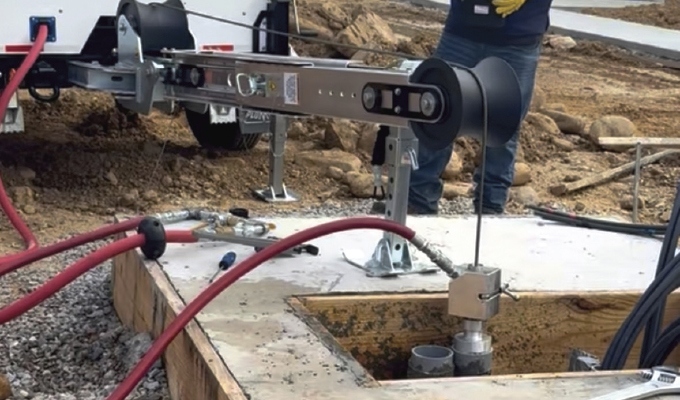
The underground cable pulling industry has operated on the same basic principles for decades. A diesel-powered hydraulic unit pulls distribution and transmission cable through conduit, while an onboard compressor blows what is commonly called a “bird” attached to a pilot line through the duct to establish the pulling path. The formula works, but it comes with tradeoffs contractors have simply accepted: noise that makes crew communication difficult, weight that limits towing options, and dimensions that complicate urban deployments.
When my team at Plumettaz set out to develop new equipment, we started with a fundamental question: What would a cable puller look like if we designed it around actual field challenges rather than legacy configurations? The answer led us to architecture that addresses longstanding pain points while opening new operational possibilities.
THE WEIGHT AND WIDTH PROBLEM
Many competitive units approach 100 inches in width and weigh 6,000 to 7,000 lbs. That width extends past the body of most pickup trucks, requiring extra caution on every turn. The weight demands a heavy-duty tow vehicle and increases fuel consumption.
Eliminating the diesel engine and hydraulic systems immediately removes 800 to 1,500 lbs. The result is the E-Air 7500, our battery-driven cable puller weighing 4,700 lbs. with a gross vehicle weight rating of 5,200 lbs. The compact dimensions of 170.75 inches long by 79 inches wide allow the unit to fit within the body width of an F-150 pickup. When your equipment fits within your tow vehicle’s profile, you eliminate the constant vigilance required when the trailer extends past your mirrors.
With no engine block dictating component placement, we achieved near-perfect weight distribution with approximately 120 lbs. difference between left and right tire loading. The unit sits at precisely 10 percent tongue weight, delivering stable towing at highway speeds without the sway that plagues poorly balanced equipment.
WHEN SILENCE BECOMES SAFETY
The most significant operational improvement might be the one that contractors notice immediately: an electric powerplant is quiet.
On a conventional cable pull, the crew member operating the remote on the pulling side often cannot hear colleagues on the other end of the conduit. When there is a snag or obstruction, the pulling operation must stop immediately. Two or three extra feet of pulling force can damage the conductor or equipment.
Diesel-powered units force crews to walk away from the machine to communicate, wear headsets, or rely on hand signals. These solutions add complexity and introduce potential for miscommunication.
With the electric drive system, operators can place a phone on speaker in a shirt pocket and maintain continuous voice communication with the receiving crew. When someone says “stop the pull,” everyone hears it. This transforms jobsite coordination from a logistical challenge into a simple conversation while reducing worker stress.
URBAN APPLICATIONS AND DATA CENTER WORK
The combination of compact size and quiet operation creates particular advantages for inner-city utility work and data center construction.
Urban cable pulls often occur in constrained spaces near businesses and residences. A cable puller that can position directly over a manhole or vault without blocking an entire street brings obvious advantages. When that equipment operates without diesel engine noise, contractors can work within urban cores during business hours or adjacent to noise-sensitive locations without generating complaints.
Data center construction represents an expanding opportunity for cable contractors. These facilities require extensive conductor installation and increasingly demand multi-duct configurations for future fiber capacity. The E-Air 7500 handles multi-duct pulls, preparing conduit systems for the fiber optic infrastructure these facilities depend upon.
COMPRESSOR INTEGRATION
The onboard air compressor blows the bird through the conduit before the pull begins. We worked with Vanair engineers to integrate an underdeck rotary screw compressor system configured for electric drive. We chose Vanair due to the company’s industry knowledge, existing product line, and reliability.
The compressor delivers 100 CFM at 100 PSI. Those specifications reflect careful engineering around battery-powered operation realities. The same compressor platform can produce 185 to 200 CFM at higher pressures, but that output would drain the battery rapidly. At the configured output level, the compressor provides ample capacity for bird blowing while preserving battery life for pulling.
A typical pull might require five minutes of compressor operation followed by 10 to 15 minutes of pulling. At a recent demonstration with local utility crews, the unit completed two full pulls in half a day and showed 90-percent battery capacity remaining.
The compressor system carries a lifetime warranty on the air end when maintained according to schedule. This reflects the durability of the Vanair rotary screw design, which has proven itself across decades of mobile power applications. For contractors accustomed to treating compressor rebuilds as an inevitable operating expense, that warranty represents meaningful cost certainty.
SERVICEABILITY BY DESIGN
The E-Air 7500 uses four battery modules providing 20 kilowatt-hours of total capacity. These marine-grade batteries carry IP67 ratings for water and dust resistance. The battery replacement procedure takes approximately one hour. Technicians drop the bottom access panels, lower the battery with a floor jack and install the replacement. There is no specialized equipment required and no dealer-only service restriction.
The electrical architecture extends this serviceability philosophy throughout the machine. The sheet metal enclosure over the compressor lifts off for full access. Oil drains route to ground level. Components are arranged for logical service access rather than squeezed around an engine block.
The E-Air 7500 accepts multiple charging inputs. The SAE J1772 port accommodates standard EV charging equipment. A NEMA L14-30P connection provides an alternative. Additional 16-amp charger options include NEMA 5-15, 5-20 and 10-30 connections spanning 120 and 240-volt service.
This flexibility means the unit can charge at a contractor’s shop, at a customer facility, or from a portable generator on remote jobsites.
A DIFFERENT CALCULATION
The decision to specify cable pulling equipment has traditionally balanced capability against cost, with weight, noise, and complexity accepted as inherent characteristics. Advancing technologies are changing that calculation.
For contractors evaluating their next equipment purchase, the question is no longer simply how much pulling force the application requires. It is whether the operational advantages of electric drive, compact dimensions, and quiet operation align with how and where they actually perform their work.
about the author
Matthew Faircloth is design engineer at Plumettaz America Corp., based in Soddy Daisy, Tennessee. He was instrumental in the development of the E-Air 7500 all-electric cable puller, working closely with component suppliers to integrate battery-electric technology into the Plumettaz winch platform. Plumettaz America Corp. is a division of the Plumettaz Group, the Switzerland-based world leader in cable laying equipment that has pioneered mechanical innovations for telecommunications and utility industries since 1923. For more, visit www.plumettaz.com.