

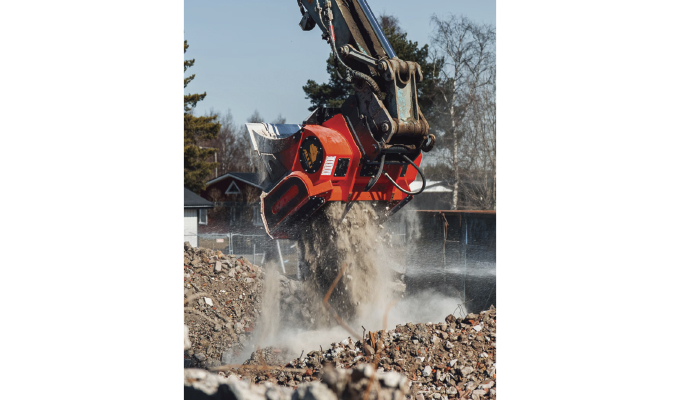
Demolition work can remain expensive long after the structure is down. Every time concrete rubble is loaded, moved, stockpiled, reloaded, or hauled somewhere else for processing, contractors spend more on fuel, labor, and machine hours.
The challenge becomes even greater on urban and space-restricted jobsites, where bringing in a separate mobile crusher can add another machine, another material flow, and another logistical problem.
The ALLU Concrete Bucket was developed around a simple idea: Instead of taking the material to the processing equipment, bring the processing to the material.
Designed for excavators in the 55,000- to 100,000-lb. class, the 5,500-lb. attachment crushes and screens pulverized demolition concrete where it is generated. It accepts feed material up to 11 inches and produces either 0- to 2-inch or 0- to 4-inch output. Under suitable material and operating conditions, processing capacity can reach up to 110 U.S. tons per hour.
That means one excavator can pick up the material, process it, and place the finished product without waiting for a separate crushing setup.
For Ursa Demolition in Finland, that approach has already delivered practical benefits in the field.
“We’ve been extremely happy with the end result. The production capacity is remarkably higher than with a jaw crusher attachment, and the 5,500-lb. weight makes it stable to handle. You can also reach further with a 75,000-lb. excavator,” says Jonathan Bjon, CEO of Ursa Demolition.
KEEP WORKING WHEN REBAR IS IN THE PILE
Demolition rubble rarely arrives clean. Pulverized concrete can contain brick, fines, dirt, asphalt fragments, oversize material, and remaining pieces of rebar or other steel. Even after the crew removes larger, valuable steel, smaller pieces can still be mixed throughout the pile.
The ALLU Concrete Bucket is designed to tolerate rebar and other steel contamination in the feed. Steel fragments can pass through the bucket or be discarded as rejects, reducing the need to prepare perfectly clean material before processing.
“This bucket is built for the real world: fines-heavy material streams, tight spaces, and reinforced concrete that doesn’t arrive clean,” says Antti Rautamies, head of R&D at ALLU.
For contractors, that means less time preparing material for the crusher and more time processing the rubble as it is encountered.
Its heavy-duty frame and cutting edge are designed to withstand the breakout forces of excavators up to 100,000 lbs. The integrated Drain Line Eliminator removes the need for a separate hydraulic drain line on suitable carriers, simplifying connection and helping contractors move the attachment between compatible machines.
CRUSH WHAT NEEDS CRUSHING
Instead of a traditional jaw-crushing action, the ALLU Concrete Bucket uses three rotating crushing drums fitted with replaceable carbide picks.
As demolition material moves through the bucket, fines can screen through while larger pieces are directed toward the crushing plates. Two-way drum rotation reverses the material flow, allowing both the upper and lower crushing areas to be used while helping maintain an even flow through the bucket.
This is particularly useful with pulverized demolition material containing a high proportion of fines. Material that is already small enough does not need to be crushed again, while larger pieces continue through the crushing process.
The carbide picks are replaceable wear parts, making them practical to change on site when working in abrasive demolition material.
CHOOSE THE OUTPUT FOR THE NEXT STAGE
Crushing concrete is rarely the final objective. Contractors need material that works for whatever comes next. Changeable counter-blade sections allow the ALLU Concrete Bucket to produce either a 0- to 2-inch or 0- to 4-inch output.
The finer setup can produce a more consistent fraction for reuse, stockpiling, transportation, or further processing. The coarser setup can support greater material flow or prepare rubble for another stage of processing.
Depending on local specifications and material quality, processed concrete may be suitable for applications such as fill, base material, or further recycling. This flexibility allows contractors to produce material for different end uses without changing the entire processing setup.
WHEN ANOTHER CRUSHER IS TOO MANY
There are projects where a dedicated mobile crusher remains the right solution. But not every demolition job needs, or has room for, a complete crusher setup.
On smaller, urban, or space-restricted sites, the ALLU Concrete Bucket can operate as the primary on-site processing tool. The excavator already working around the pile can process the material instead of adding another machine to the job site.
The question therefore is not always whether an attachment can replace a mobile crusher. It is how many machines and handling steps a particular job really needs.
FEWER STEPS MEAN MORE PRODUCTIVITY
Maximum hourly capacity matters, but the bigger productivity gain may come from the work that no longer needs to happen around the crushing process.
If the excavator can pick up reinforced rubble, screen out fines, crush larger pieces, produce the required fraction, and place the processed material, contractors can potentially reduce loading, reloading, stockpile movements, and hauling.
That can mean fewer machines competing for space, fewer interruptions, and fewer hours spent moving material simply so it can be processed somewhere else.
The ALLU Concrete Bucket turns crushing and screening into part of the excavator’s normal workflow. Rather than adding another processing operation to the demolition site, it helps contractors shorten the route from rubble to usable material.
For a contractor looking at a pile of concrete already on the ground, that leads to a straightforward question: How much of the processing can be done right where the work is already happening with the existing machinery?