

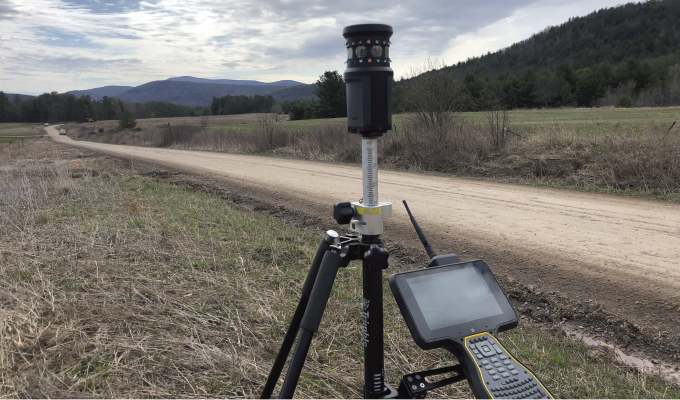
Road construction is in the middle of a quiet but significant evolution. The underlying solutions driving it are familiar—namely, machine control, reality capture, and integrated software. But the way those tools are connecting across the full project lifecycle is changing what contractors can deliver, how quickly, and at what cost.
Smarter data use is turning into tangible savings, faster and more accurate as-builts, and a competitive edge. A Utah-based heavy civil contractor is eliminating weeks of back-and-forth by putting real-time project data directly in field crews’ hands. A Minnesota paving contractor relies on a data hub to better manage up to 200 trucks across projects. A heavy highway contractor in New York is building toward an operation where administrative workload drops 80 percent. All of these outcomes come from information moving more freely across project teams.
These connected workflows are also building the data foundation that AI needs to observe conditions across an entire project, coordinate actions across multiple systems, and direct the right information to the right person before a problem becomes a delay. The basis for that future is already layered into the mix, paving the way for a fundamentally different kind of jobsite intelligence.
DATA IN MOTION
Today’s streamlined workflows start with shared data, a common data environment where survey data, design models, machine control files, progress photos, and as-built records converge into a single source of truth that every member of the project team can access and contribute to. Field crews have current design files in hand before the workday starts. Project managers see a live picture of progress. Owners stay informed without having to chase updates.
Utah-based WW Clyde puts that principle to work across highway corridors, data centers, solar installations, and pipeline projects, by pulling data from mobile LiDAR scanning, grade control systems, and field management tools into the same digital ecosystem.
The impact is sharpest when things change. On a recent project, drone-captured data facilitated design modifications that were reviewed, approved, and implemented in the field within hours, compressing what would typically be a weeks-long process into a single day and saving significant costs in schedule delays. Upon project completion, the team produced a final scan as a comprehensive as-built record, documentation that protects against disputes, informs future bids, and builds a growing library of project intelligence.
A bid-to-field connection delivers equally tangible results in daily operations. Bituminous Roadways, a Minneapolis-based paving contractor, uses integrated software to flow bid data directly into field tracking and scheduling, enabling dispatchers and foremen to coordinate crews, equipment, and materials in real time, including up to 200 trucks daily during peak season.
CLOSING THE LOOP
The same connected philosophy drives Richmondville, New York-based Lancaster Development in the office and in the field. Mark Galasso, president of the highway and civil construction firm, is direct about what makes or breaks a technology-driven operation: being slow and being chaotic are the two most dangerous things for any business, and both trace back to the same root cause—not having accurate data when you need it.
Lancaster runs an integrated stack spanning estimating, field tracking, equipment maintenance, and scheduling software, with an ERP implementation underway to bring financial management and HR into the same data stream. Machine control and 3D modeling have been part of the field operation for more than two decades. The current efforts are closing the loop between field and office so that every data element has one source of truth and flows automatically to every system that needs it without rekeying, without lag, and without errors introduced in translation. Galasso’s target is an 80 percent reduction in administrative workload and with it, a cost of growth that approaches zero.
That foundation is also what makes the next steps with A.I. possible. Advanced A.I. solutions are already adding value for tasks such as point cloud classification, pavement condition assessment, automated feature extraction, and improved estimating accuracy, automating work that once required hours of specialized effort and putting structured, actionable data in front of the people who need it.
The more significant shift is agentic A.I., systems that don’t just analyze data when asked, but continuously monitor workflows, retrieve relevant information, and act on what they find without waiting for human instruction at every step. One of the largest contractors in the United States is already piloting this capability for submittal reviews, a workflow that generates more than 150,000 submittals annually with projected efficiency improvements running into the millions of dollars across that single workflow alone. Multiply that across the RFIs, change orders, daily reports, and permit requests that flow through a major contractor’s operations every year, and the scale of what becomes possible is significant. That potential depends entirely on the kind of connected, interoperable foundation that Lancaster, WW Clyde, Bituminous Roadways, and contractors like them are building today.
The path forward is the same one these contractors followed: Identify where friction is highest, solve it well, and build outward. Whether that starts with estimating, machine control, a common data environment, or reality capture depends on the operation—but the direction is consistent: fewer handoffs, more shared visibility, and systems that multiply the value of the people running them.
Road construction has always rewarded preparation, precision, and execution. The technology available today doesn’t change those fundamentals; it extends them, giving contractors the visibility and accuracy to deliver on commitments that would have been difficult to make with confidence just a few years ago. For the contractors building toward it, that’s a meaningful and durable competitive advantage.
about the author
Kevin Garcia is general manager of civil specialty construction for Trimble. In this role, he is responsible for multiple product groups serving the civil specialty construction market, including paving, landfill construction, drilling and piling, and more. Prior to this position, he served as paving product manager for seven years. He has more than 20 years of experience in the asphalt and concrete paving industry, including six years with Lafarge. He earned his Bachelor of Science degree in Civil Engineering from the University of Wyoming.