

Whether it’s a residential construction project in the Dallas-Fort Worth area or commercial projects in Florida and Tennessee, the contractors who successfully navigate today’s most complex and demanding jobsites all have one commonality: Technology is the foundation of their success.
The modern jobsite is fraught with potential pitfalls, from increasing demands on efficiency to reducing waste to tackling the prolonged skilled labor shortage.
As jobsite tools like laser scanners, total stations, and machine control become more common, younger workers are interested not just in the jobsite itself but in the chance to use the latest sophisticated technology to solve real-world problems and advance their careers.
According to the Associated Builders and Contractors, the industry needs about 349,000 new workers this year to meet demand. That number could rise to 456,000 in 2027, but many contractors still struggle to find and retain the right people for today’s jobsites.
Technology, coupled with mentorship and opportunities, can help current employees gain new skills and younger team members grow their careers by providing a broader understanding and hands-on experience across roles and machines.
TECHNOLOGY ATTRACTS THE NEXT GENERATION
For Mt. Pleasant, Texas-based Stephenson Dirt Contracting, technology is as critical to tackling large-scale residential projects as it is to attracting new—and often younger—workers.
New solutions are user-friendly, which simplifies training for all workers. They are also a powerful tool for attracting a younger generation of digital natives, for whom technology is second nature, to the industry.
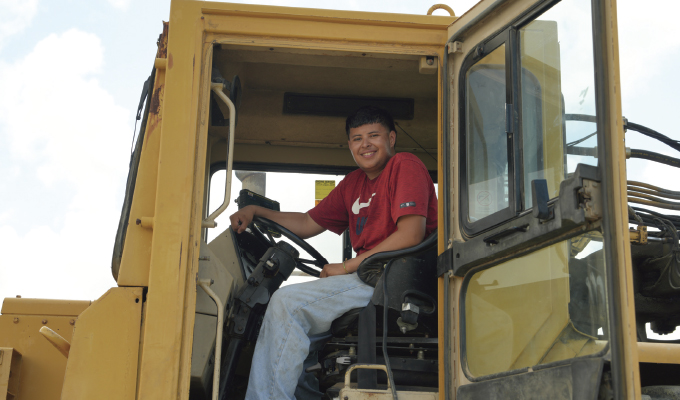
Retrofitting machine control on older equipment, such as Cat scrapers, has several advantages. First, it boosts the equipment’s value by improving productivity. It also allows Stephenson Dirt’s team members, such as 21-year-old Oscar Miranda, to operate a range of machines, including backhoe loaders, excavators, and skid steers, helping him gain a broader understanding and operating experience in various roles and machines.
“The skid steer was a lot of fun to drive, and I learned a lot about how to handle it in different tasks, from shifting dirt to moving other materials around and generally keeping the yard clear,” Miranda says. “It was definitely the best machine to start on, as I had to quickly learn how to operate the joysticks and change attachments.”
Once he had mastered the skid steer, Miranda went on to operate a backhoe loader.
“With the backhoe again being a utility machine, I found myself doing even more tasks like learning how to dig trenches,” Miranda adds. “This then helped me to progress into working on excavators. But I always had my eye on the bigger machines, so I pushed myself hard to get an opportunity to work on a dozer.”
During a recent residential project in Dallas-Fort Worth, Stephenson Dirt needed precise grading and ditch shaping for hundreds of plots. They also had to handle changes in the volume of dirt caused by water saturation.
The team needed to coordinate in real time with clients, which meant efficiently training new operators in GPS and machine control. To ensure the project is graded according to specification and to eliminate the risk of costly rework, the team installed Leica Geosystems machine control solutions on its equipment.
For Stephenson, the project wasn’t just about testing the technology. It affirmed that digital tools could accelerate the training of a new generation of operators.
TECHNOLOGY CATCHES MISTAKES EARLY
For Jacksonville-based Superior Construction, coordinating projects at Nashville International Airport and the First Coast Express in Jacksonville, Florida, required a different type of technology deployment: automating its pavers.
By mounting robotic total stations—electronic and optical instruments that enable users to lay out points more accurately—on a tripod, Superior monitored progress and collected data on each project. Doing so sped up construction and enabled the Superior team, much like the Stephenson Dirt team, to pave the road as close to the design as possible, using only the necessary materials, eliminating waste and the potential need for costly rework.
The solutions also enabled the teams to complete the project with an eye toward the future. They created a digital twin of the project, providing an exact replica overlaid with design plans, so teams can assess the entire site rather than just one-off spot checks.
The technology provides a more complete file, allowing teams to see exactly where the materials went and empowering them to address any errors quickly. It can also be recalled for analysis at any time.
“Leica Geosystems technology is now even more precise and easier to use,” says Tim Gebauer, survey manager for Superior Construction. “I feel like that technology is making it safer for operators.”
A.I. ELEVATES JOBSITE SAFETY
While GPS and machine control helped solve efficiency problems, as jobsites grow even more complex, the challenges contractors face today demand even more sophisticated solutions.
Artificial intelligence is transforming construction by accelerating workflows, helping teams manage data and projects more efficiently, and boosting safety with real-time alerts. Yet, its greatest value to operations is still emerging.
As job sites tighten schedules, operate with fewer workers, and enforce stricter rules, integrated safety tools backed by intelligent, adaptive A.I. systems help contractors to enhance jobsite safety.
By monitoring job sites in real time, teams can quickly identify potential hazards and recommend immediate protective actions. They can also analyze incidents to identify patterns and inform future safety strategies and potential preventive measures.
A.I. ensures teams are working according to plan by monitoring progress and comparing it against project models, saving money by eliminating costly repairs, and increasing productivity through automated task management. The vision is to equip every construction tool and machine with A.I., enabling teams to receive real-time data and recommendations, supporting better, faster decision-making on the jobsite.
Enter the Leica Xsight360 safety awareness solution. It uses edge-based A.I. and up to six onboard cameras to provide operators with full 360-degree visibility around heavy equipment. The end-to-end solution unites machine automation, awareness, and construction specific A.I. algorithms to tackle these challenges directly.
The system detects people, vehicles, and obstacles in real time, issuing immediate audio and visual alerts to mitigate risks before incidents occur.
Technology is no longer a nice-to-have; it’s integral to a company’s success. It saves time and money and improves jobsite safety, building talent and reducing waste, and attracting younger workers like Oscar Miranda into the fold.
about the author
Troy Dahlin is vice president of heavy construction and machine control for Leica Geosystems. For more, visit www.leica-geosystems.com.