

On urban infill construction projects and high-density residential builds, contractors face one particular hurdle that can affect safety, costs, and the project timeline: the added risks and scrutiny associated with on-site fuel storage. In these congested construction environments, a non-compliant fuel tank isn’t just a safety risk—it’s potentially an extremely costly project delay.
Understanding how to navigate these complex fueling scenarios and knowing what to look for in tank solutions can help contractors reduce risks on these projects and ensure that they meet the most stringent fire safety standards from day one.
HIGH-DENSITY CONSTRUCTION SITES
These types of jobsites can be congested, crowded environments, and often they are happening near existing businesses or residential buildings. The proximity to people and surrounding structures makes these builds higher-risk situations.
On spacious, more remote jobsites in less crowded areas, fuel equipment can be placed in a more secluded location or be blocked off. But fuel storage on an urban construction site poses different challenges, and a non-compliant fuel tank can be a significant safety risk and a source of project delays. The added challenges on these jobsites include:
Elevated public risk: When a fuel tank is stored near a sidewalk or an adjacent building, this poses higher risk. Fuel tanks that offer basic containment may lack the robust protection needed to withstand physical damage that could lead to fires or explosions. If an accident occurs in a tight urban space, the consequences extend beyond a standard cleanup. It could become a threat to public safety and the environment.
Greater regulatory scrutiny: Because of the risks associated with crowded urban job sites, local fire marshals and authorities may opt for tighter regulations. High-visibility locations, such as high-rise projects in New York City or Chicago, may be subject to frequent, unannounced fire marshal inspections. This leaves zero room for error, especially when storing flammable fuels.
Hidden costs of non-compliance: If a fire marshal issues a warning or shuts down fueling operations due to a non-compliant fuel tank setup, it could result in costly downtime—perhaps thousands of dollars per day in wasted labor, equipment rental fees, and compounding timeline delays.
UNDERSTANDING THE REGULATIONS
When it comes to onsite fuel storage, navigating the application standards for a specific job site is not a straightforward, black-and-white process. Because regulations are not federally mandated, compliance requirements vary state by state and city by city. Each local fire code is different, placing the responsibility squarely on project managers to verify requirements with their local jurisdiction before choosing fuel storage equipment. This applies whether contractors are renting fuel equipment or buying their own.
Generally, local fire codes look at three primary factors to determine what kind of tank is allowed on-site: the type of construction site, the tank’s proximity to public structures like roads and buildings, and the specific liquid being stored.
To secure a stamp of approval from local fire marshals, contractors must ensure that their fuel storage solutions meet the appropriate Underwriters Laboratories (UL) safety standards. UL142 and UL2085 are common standards that apply to above-ground fuel storage.
UL142: This is a widely recognized safety standard for above-ground tanks. While highly effective and reliable, UL142 tanks provide basic secondary containment that is best suited for secluded, low-risk or rural sites where proximity to other structures is not an issue.
UL2085: This standard represents a higher tier of safety designed for extra protection of a tank and its contents. Tanks of this specification are often double walled—insulation that allows them to withstand extreme heat and fire risks. Additionally, UL2085 tanks feature robust ballistic and impact resistance, providing extra protection against physical damage from vehicles or heavy equipment operating nearby and even from people outside the jobsite.
The major difference between UL2085 and UL142 tanks is that UL2085 tanks offer more protection. The UL142 acts as the basis for fuel tank manufacturing; to meet UL2085 standards, extra materials and features are added.
In the past, fire-protected storage tanks were most commonly used in permanent fuel tank installations, but they are now increasingly used in temporary and semi-permanent applications that last anywhere from a few months to a few years. That shift is happening as local fire marshals place a greater emphasis on public safety and more frequently require UL2085-rated tanks for storing flammable fuels on high-density construction projects.
Beyond local fire codes, contractors must also meet federal environmental mandates for fuel storage on a site. The Environmental Protection Agency (EPA) enforces Spill Prevention, Control, and Countermeasure (SPCC) plans on active construction sites. The SPCC plan requires a comprehensive strategy by contractors to prevent and control fuel or oil spills. Failing to meet these regulations can lead to costly environmental cleanup processes and EPA fines for contamination.
CHOOSING FIRE-PROTECTED FUEL STORAGE
To gain peace of mind for both fire-code compliance and SPCC standards, more construction contractors are choosing fire-protected tanks from the start on their urban jobsites. Proactively selecting a compliant, certified tank helps safeguard the project timeline from unannounced inspections, unexpected shutdowns, and the costs of mid-project retrofitting. A fire-protected tank might also allow contractors to reduce setback distances from structures and property lines to help optimize space on a crowded site.
When it comes to fire protection, it’s important to first and foremost select a tank with a UL2085 stamp. Beyond that, there are numerous features to consider when choosing a fuel tank for an urban site, including:
Secondary containment: Some tanks offer 110-percent secondary containment to meet SPCC standards enforced by the EPA.
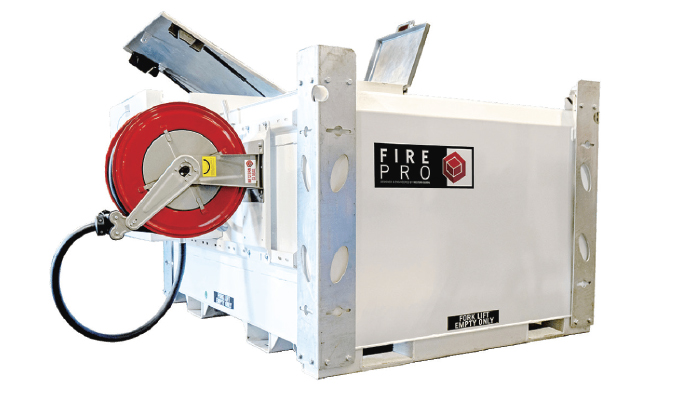
Ease of mobility: Fuel tanks on a construction site may be frequently moved. Look for a UL2085 tank with four-way fork pockets for quick and easy maneuvering and mobility when empty.
Turnkey tanks with pump packages: Plug-and-play tanks arrive on site with preinstalled pump packages for a contractor’s fueling needs to ensure site-specific efficiency.
Spill protection: Tanks with a built-in lockable spill box offer better spill protection compared to traditional tanks with spill pans, which can be a hassle to clean and maintain.
Security and theft prevention: Tanks with a lockable equipment cabinet help keep fuel, ports, and equipment safe on busy, crowded construction sites.
A small footprint: A tank with a smaller footprint than that of traditional round tanks allows for more efficient site layouts and placement near structures. Square tanks are also easily stackable when empty (up to two high) to save space.
Time is money on these high-density sites, so contractors should check local fire codes early to verify the requirements with their local jurisdiction before selecting fuel tank solutions.
about the author
Sydney Talbot is product manager for Western Global. For more, visit www.western-global.com.