

In the construction industry, success depends on careful planning, precise scheduling, and the ability to adapt quickly. For Saunders Construction, a Colorado-based general contractor known for its innovation and forward-thinking culture, project scheduling has always been central to delivering on time and within budget.
Since 2014, Saunders has relied on Elecosoft’s Powerproject to manage schedules across its portfolio of projects. But by 2022, the company recognized a growing challenge: while Powerproject itself worked flawlessly, the management of schedule files had become increasingly complex. Disparate storage locations, version-control headaches, and the inability to run consistent analytics across projects were slowing down efficiency and creating unnecessary risk.
The solution came in the form of Asta Vision, Elecosoft’s collaborative platform designed to augment Powerproject. Implemented in late 2022, Asta Vision has transformed Saunders’ scheduling processes: streamlining version control, enabling robust analytics, and raising overall schedule quality across the organization.
POWERPROJECT AT THE CORE
When Saunders first onboarded Powerproject over a decade ago, it immediately became the backbone of scheduling operations. Project superintendents, engineers, and managers relied on it daily to build, manage, and update project schedules.
Clayton Neiman, continuous improvement manager at Saunders, recalls how the system worked in those early years: “We had carried our construction schedules through the platform for quite a number of years. But one of the issues we were trying to tackle was that the actual schedule files themselves were still in disparate locations all across our project drive, existing in various iterations. Just answering the simple question, ‘What’s the latest and greatest version?’ could be very time-consuming.”
Although Powerproject delivered the scheduling functionality they needed, the scheduling process lacked a way to centralize, control, and analyze data across the enterprise. As projects grew in size and complexity, the need for a more unified approach to scheduling management became increasingly necessary. Files were scattered across drives, duplicated by multiple users, and often updated without a clear record of changes. Teams wasted valuable time trying to determine which version of a schedule was current, while leadership struggled to maintain oversight across projects. Without consolidation, there was no easy way to generate meaningful analytics or ensure consistency.
ENTER ASTA VISION
In November 2022, Saunders implemented Asta Vision, Elecosoft’s cloud-based schedule management and analytics tool. “We chose Asta Vision because it pairs so closely with Powerproject; it needed to be seamless for our teams,” says Neiman. “There are other schedule-analysis tools, but none that actually house the schedules, version them, and allow our team members to check them in and out so easily.”
That seamless integration became a key differentiator. Teams could open schedules directly in Powerproject, check them out, and return them without disruption. Every file update automatically triggered both a new version save and a quality analysis. At the same time, corporate leadership gained visibility into schedule health across the entire organization.
The first phase of Saunders’ Asta Vision rollout was focused on centralizing files and establishing reliable version control. Initially, some teams expressed apprehension about relinquishing what they viewed as personal control over their project schedules. Yet this stage gave teams a new sense of transparency, since they could immediately see who was working on a file. It also introduced full traceability, with every revision logged along with its author and timestamp. Most importantly, it provided resilience: if a change went wrong, earlier versions could be restored instantly. Combined, these changes addressed Saunders’ most pressing challenge: ensuring that everyone worked from the same, current schedule.
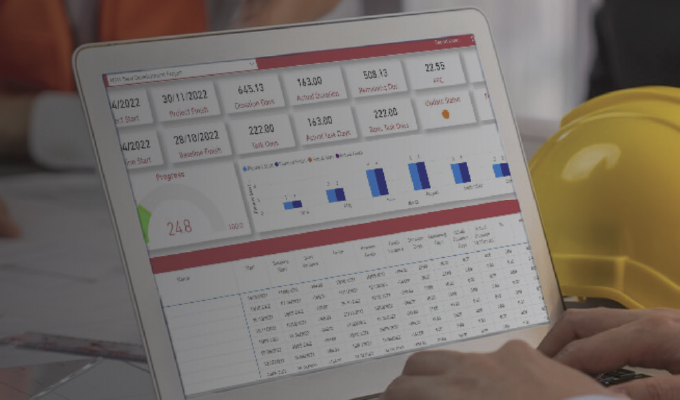
Once teams grew comfortable with centralized scheduling, Saunders began to tap into Asta Vision’s analytics and automated quality checks. The system evaluates schedules on criteria such as task logic, execution, and criticality, generating a quantifiable “health score” for each project. The first time Saunders activated the Asta Vision dashboards, the results were revealing, as the scores weren’t quite where they expected them to be. However, the improvement was both immediate and measurable. Teams could now locate bottlenecks early and correct them before they became major problems. Automated reports highlighted specific problem areas and even guided schedulers directly to the issues that required attention.
With these checks in place, Saunders was able to enforce best practices across projects and establish a consistent baseline for scheduling quality. The result was greater confidence that every schedule represented not just a timeline, but a reliable, workable plan. And according to Neiman, those scores have gone way up over the past year—about 20 points on average.
COMPANY-WIDE ROLLOUT
By 2024, Saunders had rolled out Asta Vision company-wide, making schedule analytics and dashboards part of everyday operations. Superintendents, who carry responsibility for field execution, became the primary users, while project engineers and managers supported development and reviews. Corporate leadership also embraced the system, using its real-time reporting capabilities to maintain visibility across the organization.
The platform’s ease of use has been critical to its adoption. As Neiman notes, “It’s automatic. Every time a schedule gets checked back in, its data gets updated. We know where that file’s at, and we can run the analysis immediately.”
As with any new system, implementing Asta Vision required attention to change management. Some team members worried that the dashboards might be used to monitor or penalize their work; Neiman acknowledges this initial concern. “There was a sense that Big Brother was watching. But once everyone understood that the tool was about improving schedule health and reducing project risk rather than policing individuals, the buy-in improved. Our superintendents would agree we now have better schedulers.”
Leadership support played a crucial role as well. From the president down, Saunders reinforced the cultural message that schedules are vital assets. “At our core, we are a company of exceptional builders,” says Neiman. “Asta Vision reinforces our ongoing commitment to our planning initiative, emphasizing the importance of continuous adaptation and collaboration.”
The integration of Asta Vision has delivered clear and tangible benefits. As noted earlier, average schedule quality scores improved by about 20 points. Teams gained the ability to identify and resolve issues faster, while collaboration improved thanks to real-time visibility into file ownership and version history. Across the board, project schedules became more consistent, and risk was reduced as healthier schedules provided more reliable execution.