

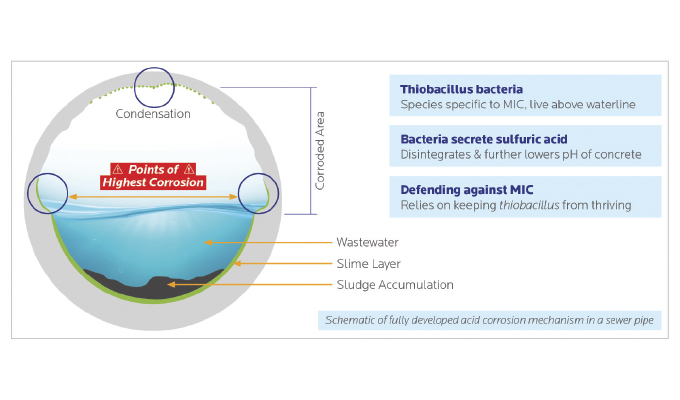
Due to high concentrations of sulfuric acid on the surface, chemical corrosion causes concrete sewer pipes and wastewater infrastructures to deteriorate at unexpected, rapid rates. Microbially induced corrosion in concrete (MICC) is a multistage process that converts waste products into corrosive acid. Microban, in partnership with MarMac, explored these stages and recorded how quaternary silanes that offer robust efficacy with an optimal concrete compositional design can effectively combat MICC.
THE MECHANISM OF ACID DEGRADATION OF CONCRETE
A complex microbial process generates sulfuric acid. In the sludge below the sewage surface, anaerobic organisms, those living without oxygen, metabolize sulfates to create hydrogen sulfide gas. The gas is then released into the air above the waterline and absorbed into the moisture layer on the concrete walls. Thiobacillus, an aerobic genus of bacteria living on the walls, then metabolizes the hydrogen sulfide gas into sulfuric acid. The resulting acid attacks the concrete’s cement binder, turning it into weak, crumbly substances like gypsum and ettringite that lead to structural failure.
When concrete is freshly installed, none of the elements that support the corrosion process are present; these conditions develop slowly over time. The MICC process is gradual and relies on a succession of bacterial species. Stage 1 provides inherent protection. Since fresh concrete is highly alkaline, it naturally prevents most microbial growth. Over time, a combination of moisture and sewer gases begins to lower and neutralize the concrete surface’s pH, onsetting Stage 2. This allows a succession of acid-producing bacteria, with the major species being Thiobacillus, further lowering the pH. When the pH drops low enough, the most damaging organism, T. thiooxidans, takes over, resulting in Stage 3. This microbe thrives in high-acid conditions and drives the most aggressive phase of corrosion and subsequent degradation.
LIMITATIONS OF TRADITIONAL SOLUTIONS
Many traditional methods to combat MICC focus on strengthening concrete against acid attack by adding densifiers. These methods ignore the original protection, inadvertently lowering the initial pH and shortening Stage 1 protection, which in turn accelerates the onset of Stages 2 and 3. To maximize inherent protection, comprehensive protection against microbial attack should also account for the extension of Stages 1 and 2. By Stage 3, concrete is actively corroding, meaning it would be too late to abort the process.
THE ROLE OF QUATERNARY AMMONIUM COMPOUNDS
For many decades, quaternary ammonium compounds (QACs) have been extensively used due to their good stability, relatively low toxicity, and compatibility with other chemistries. QACs are used for surface protection in an extensive range of applications, including textiles, disinfectants, soaps, hand washes, and swimming pool chemistries. QACs are also valued because of their broad-spectrum effectiveness against organisms like bacteria or fungi. Quaternary ammonium silanes are a specific type of QAC that incorporates a silane base, providing additional chemical benefits in specific applications.
OPTIMIZING EFFICACY THROUGH MOLECULAR DESIGN
Evaluating microbial effectiveness in concrete requires more than standard lab tests because freshly made concrete has a naturally high pH that inherently inhibits microbes. This can lead to a false positive when testing, because the bacterial kill is incorrectly attributed to the antimicrobial rather than to a high intrinsic pH.
The ASTM C1904-20 test method establishes a laboratory procedure for evaluating how antimicrobial-treated concrete materials perform when exposed to microbially induced acidification. Designed to simulate years of sewer service by preconditioning samples to support the growth of Thiobacillus, this method shows how specific long-chain quaternary silane formulations maintain a “protective window,” even as biogenic acidification attempts to take hold. By comparing molecular analogs, the evaluation reveals that the right chemical structure can significantly delay microbial colonization, offering a data-driven path toward extending the service life of critical infrastructure.
DUAL-LAYERED APPROACH
To effectively combat MICC, a dual-layered approach must be considered, focused on the first two stages of the corrosion cycle. First, prioritize Stage 1 protection by favoring concrete compositions with a high starting pH of at least 12. The primary goal is to maintain this high intrinsic alkalinity as long as possible, as it provides the first line of defense against microbial colonization. Be cautious with additives like silica fume. Although they increase strength, they can inadvertently lower the initial pH and potentially shorten the Stage 1 protection period.
Second, implement an antimicrobial Stage 2 protection. Antimicrobials should be selected through a rigorous process, including minimum inhibitory concentration testing and comparative performance evaluations in low-pH environments that support Thiobacillus growth. The ideal additive remains active across a wide pH range, allowing it to suppress microbial acid production even as conditions become more acidic.
The conclusion underscores the high stakes of infrastructure protection. Current literature suggests that without such specialized microbial intervention, the expected service life of concrete structures, typically designed for 100 years, can be reduced to as little as 30 years. By proactively addressing the biochemical mechanisms of decay, municipalities and engineers can move toward more sustainable and durable wastewater systems.
about the author
James Rapley is liquid formulations manager at Microban International. For more, visit www.microban.com.