

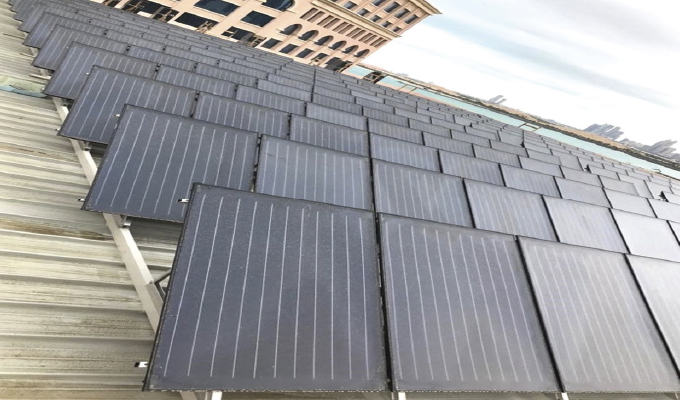
Solar thermal is often discussed as a sustainability solution. But on residential and hospitality projects, the first question is usually much simpler: Where will the system fit?
The technology itself is not the main obstacle. Solar thermal systems are available, proven, and relevant for buildings with regular hot-water demand. The more practical challenge is whether a project has enough usable rooftop space, and whether that space has been planned early enough to allow the system to perform properly.
This distinction is key. In many projects across the world, solar thermal is considered after the building design has already advanced. By that stage, the rooftop may already be allocated to HVAC outdoor units, water tanks, solar PV panels, access pathways, safety clearances, architectural features, and other MEP (mechanical, electrical, plumbing) services. What may appear as available space on a drawing can quickly become limited once technical, operational, and maintenance requirements are applied.
For residential and hospitality sectors, this is especially relevant. Villas, residential communities, hotels, resorts, staff accommodation, wellness facilities, and back-of-house operations often have steady hot-water requirements. This makes solar thermal a meaningful option within a broader energy-efficiency strategy. However, the system cannot be viewed in isolation. It has to be assessed alongside the building’s hot-water profile, roof layout, structural considerations, maintenance access, and competing rooftop priorities.
In hospitality, the issue becomes even more complex. Hotels and resorts have continuous operational demands and high expectations around reliability, aesthetics, comfort, and service continuity. A solar thermal system may support hot-water generation, but its integration must not compromise access to other equipment, create maintenance challenges, or interfere with the overall building operation. For operators, the question is not only whether solar thermal can be installed, but whether it can be installed in a way that supports long-term performance and serviceability.
Residential projects face a different challenge: timing. In villas, towers, and communities, solar thermal integration is usually easier when it is considered during the early design and MEP coordination stages. When it is treated as a late-stage addition, project teams may find that the roof is already crowded or that the system requires design adjustments that could have been avoided with earlier planning.
WHERE TO BEGIN
From a sales and project-development perspective, the most productive discussions do not begin with the product alone. They begin with the building. How much hot water does it require? When is demand highest? How much rooftop space is truly usable? What other systems are competing for the same area? Are maintenance access and safety clearances protected? Does the proposed solution make commercial and operational sense for that specific project?
These questions help move the conversation from general interest to practical feasibility. They also help consultants, contractors, developers, and operators make better decisions before the project reaches a point where design changes become more difficult or costly.
At Bosch Home Comfort, the focus is on helping project stakeholders match the right solution to the right building conditions. Solar thermal can be part of a strong efficiency strategy, but it should be planned with the same discipline as any other building system. That means looking at performance, space, installation, service access, and long-term operation together.
The wider adoption of solar thermal will not depend on technology alone. It will depend on earlier planning, better rooftop coordination, and a more practical understanding of how buildings actually operate. The opportunity is there, but project teams need to treat rooftop space as part of the energy strategy from the beginning, not as an afterthought.
about the author
Mohammed Melhem is sales manager for Bosch Home Comfort Group Middle East. The Bosch Home Comfort Group is a global provider of efficient heating, ventilation, and air
conditioning (HVAC) solutions with an innovative product portfolio adapted to regional needs. For more, visit www.bosch-homecomfortgroup.com.