
Concrete projects demand precision and strength at every stage of construction. Whether forming, pouring, or finishing, workers often need to access elevated areas, move heavy materials, or precisely place people or materials.
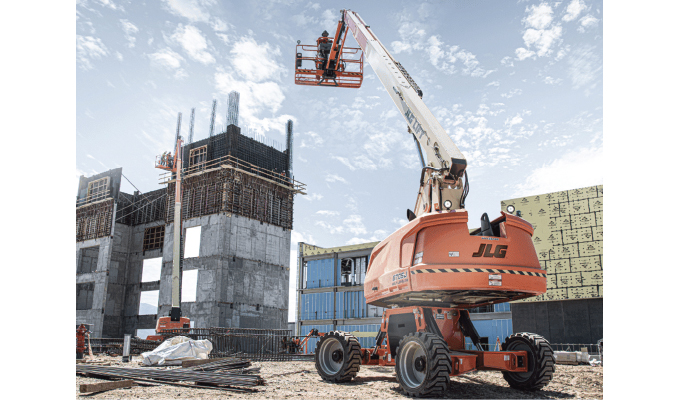
To meet these needs, access equipment like mobile elevating work platforms (MEWPs) and telehandlers have evolved concrete construction by solving complex access and material handling challenges, redefining how building projects are conceived, executed, and completed. By replacing outdated, traditional methods of reaching work at height like ladders or scaffolding, these machines enable construction teams to work more safely, efficiently, and precisely across diverse project environments.
MEWPS: PRECISION AT HEIGHT
MEWPs, including boom lifts, scissor lifts, low-level access lifts, and vertical lifts, are designed to provide elevated access to work areas. These machines are invaluable when working in high or hard-to-reach spots.
Formwork and Rebar Installation: Reaching elevated formwork can be tricky without the right equipment. Boom lifts and scissor lifts are regularly used to elevate workers to precise positions where they can install and adjust concrete forms and place rebar. Boom lifts’ flexibility, particularly their ability to extend up, over, and around obstacles, is beneficial when working in tight spaces or near completed sections of the structure.
Concrete Pouring and Inspection: When crews pour concrete, particularly in multi-story or high-rise projects, boom lifts offer access to elevated pour sites. These platforms allow workers to assist in directing the flow of concrete, ensuring an even and efficient placement. After pouring, MEWPs are also used for inspection, providing engineers and supervisors with close access to surfaces like walls, beams, and ceilings to check for imperfections or defects.
Securing and Connecting Panels: MEWPs can help concrete workers secure prefabricated concrete panels in tilt-up construction and connect these panels to steel structures. In tilt-up construction, concrete panels are cast on-site and then lifted into place using cranes. MEWPs allow workers to access connection points at the top of the panels safely, ensuring proper alignment as the panels are positioned. Once in place, workers use MEWPs to install temporary braces that stabilize the panels before permanent connections are made. MEWPs also allow workers to apply sealants, grout joints, and complete other finishing tasks. When there are embedded plate connections, MEWPs allow workers to reach and tighten bolts or weld steel components.
Prefab panels often attach to steel framing elements, such as columns or beams, requiring precise alignment and secure connections. Concrete workers use MEWPs to help attach steel embeds, brackets, and weld plates to concrete panels before they are lifted into place. After lifting panels, MEWPs provide access for bolting panel connections to steel beams or welding the embedded plates. Engineers and supervisors also rely on MEWPs to inspect and adjust the connections, verifying that everything is aligned correctly and structurally sound.
Cladding and Sheeting Installation: Once the structural framework is complete, MEWPs will assist in installing external cladding, concrete panels, and insulation. Scissor lifts or boom lifts can easily transport workers to elevated sections, making installing large concrete panels more efficient.
Light Material Lifting: Although not designed for heavy lifting, MEWPs can handle smaller loads like tools, cement bags, or buckets. This ability to move light materials quickly to elevated areas makes sure that workers have the supplies they need to complete tasks without unnecessary downtime.
TELEHANDLERS: POWER FOR MATERIAL MANAGEMENT
Telehandlers, or telescopic handlers, are versatile machines capable of both vertical and horizontal lifting. Their extendable booms are ideal for placing and moving heavy materials, which is especially common on concrete sites.
Heavy Lifting and Material Placement: Telehandlers excel at lifting and placing heavy concrete materials like steel forms, rebar, and precast concrete components. Their ability to extend the boom horizontally means they can place these heavy materials in precise positions, making them ideal for multi-story construction projects.
Bulk Material Transport: Moving bulk materials is a constant task on large-scale concrete projects. Telehandlers equipped with forks can quickly move sand, gravel, cement, or pre-mixed concrete. Their versatility also extends to transporting large blocks of concrete or scaffolding components across the site.
Supporting Concrete Pouring: Telehandlers can position buckets or hoppers, delivering concrete to higher floors or other hard-to-reach spots. Their ability to place materials where needed ensures that concrete flow remains consistent and uninterrupted during large pours.
Setting Up Temporary Structures: Telehandlers also support construction logistics by setting temporary structures like scaffolding and safety barriers. These structures help keep workers safe when working at height.
EQUIPMENT SELECTION: FACTORS TO CONSIDER
When selecting MEWPs or telehandlers for a concrete project, contractors must assess the nature of the tasks and site conditions. Concrete projects often require heavy lifting, work at height, and navigating rough, uneven terrain.
Load Capacity and Platform Size: Concrete work often involves lifting heavy materials such as concrete forms and tools. The MEWP or telehandler must be able to handle workers and the materials they are handling. Platform size is equally important—enough space must be provided for workers to move freely and safely.
Height and Reach: Accessing elevated areas is a critical aspect of concrete work. The equipment must offer sufficient vertical reach, whether pouring concrete at height or inspecting finished surfaces. Horizontal outreach is also vital, especially for boom lifts, allowing greater flexibility when working across large areas.
Stability and Safety: Stability is a key consideration since concrete projects may involve working on uneven or sloped surfaces. MEWPs with self-leveling features or outriggers help to maintain stability on rough terrain, provided the machine is used within its intended limits. Safety features such as fall protection systems, secure guardrails, and emergency lowering mechanisms are crucial for protecting workers on elevated platforms.
Maneuverability and Terrain Capability: Concrete projects frequently take place on construction sites with rough or muddy ground. A MEWP with rugged, rough-terrain capabilities can navigate these conditions more effectively. Additionally, equipment with good maneuverability allows workers to access tight spaces, such as between columns or machinery.
Operational Efficiencies: Efficiency is critical, especially during concrete pours. Contractors should look for MEWPs that can be set up quickly and move between work areas without delays. Boom lifts generally provide greater flexibility and outreach for large pours, while scissor lifts are suited for vertical movements in more confined spaces.
For outdoor construction projects, diesel-powered or hybrid MEWPs (which offer both diesel and electric power) are often preferred due to their durability and longer operational times. Conversely, electric-powered MEWPs may be necessary for indoor work to avoid emissions or meet local regulations.
Access equipment changes what we build and how we build it. As architectural designs become more ambitious and building standards more demanding, MEWPs and telehandlers expand what’s possible in concrete construction.
about the author
Craig Edwards is vice president – strategic accounts for JLG. For more, visit www.jlg.com.