
The ADU boom’s impact has been most obvious in the thousands of units it has placed in backyards across the country. Its broader effects are only now becoming apparent: Contractors can now leverage ADU-bred panelized-construction expertise into projects spanning residential, light commercial, mixed-use, and multi-unit development.
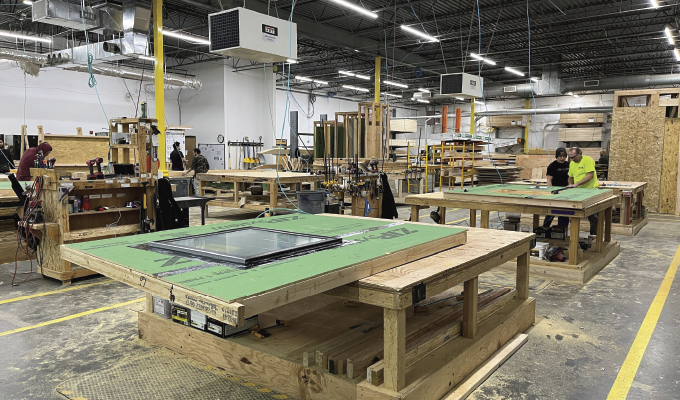
Panelized construction produces the majority of a project’s aboveground deliverables—walls, ceilings, roof trusses, and more—in factory environments with experienced personnel and tight quality control. The panels are based on flexible plan sets, and they’re shipped flat for assembly and finishing at the job site.
The gains won through panelized construction have been extraordinary. Projects can proceed 30 to 40 percent faster, with contractors in some cases seeing material and labor savings well beyond 30 percent, depending on the project type and site conditions.
Let’s drill down on the key efficiencies behind those striking numbers—and how contractors are using them to speed up work, boost margins, and even expand into new markets.
1. REPEATABLE SYSTEMS DRIVE PREDICTABILITY
Modular panels differ depending on factors such as MEP routing, penetrations, and preinstalled doors and windows, but their overall consistency makes for fast, precise builds. Factory-based quality assurance and precision manufacturing in climate-controlled environments are big factors. They reduce material waste on one hand (by roughly 80 percent), and, for contractors, mitigate many project-management headaches on the other.
Specifically, panelized construction’s predictability across cost, quality, and schedule tightens forecasting and estimating up front and brings fewer surprises, change orders, and rework in the field as projects progress.
2. QUICKER WORK AND FASTER DRY-IN
The ability to work in parallel at the site and the factory means in-factory “framing”—panel development—can precede or run concurrent with site-prep and foundation work. Add in fewer weather delays, simpler logistics and mobilization, and fewer trade-sequencing bottlenecks, and you have faster framing and enclosure.
Added bonuses: no cranes required, and flat-packed panels take up minimal storage space once onsite, which makes it ideal for infill and space-constrained sites.
3. LEANER CREWS IMPROVE LABOR EFFICIENCY
The simplified installation that panelized construction affords means smaller onsite crews, less specialized-framing labor, and, for project managers, easier manpower planning and coordination across trades, which translates into faster builds with fewer labor bottlenecks.
Onsite skills still matter, though. Factory-built systems work best when paired with experienced contractors and operators. Thanks to the growing popularity of ADUs, crews around the country are now adept at panelized jobsite work. They’re typically cross-trained to do assembly a well as siding, plumbing hookups, cabinetry installation, and even roofing and drywalling.
For contractors, that feeds back into easier scheduling and project management and also into a better weighted-average labor rate: Well-understood materials and input costs combine with predictable construction processes to minimize the need to involve costly specialist tradespeople onsite.
4. OPEN DOORS TO IN NEW JOB CATEGORIES
ADUs moved panelized construction into the mainstream. Microhousing developments aren’t far behind. Now contractors are applying panelization to workforce housing, small-lot development, multiunit communities, detached hospitality units, and light commercial and mixed-use complexes up to three stories and about 20 units.
PANELIZATION BENEFITS CONTRACTORS AND CUSTOMERS
Panelization cuts construction complexity while preserving and enhancing build quality. The functional flexibility, construction efficiencies, and cost advantages of panelization give contactors who embrace it a leg up on price, schedule, and features. Also, panelized construction yields lower-cost, energy-efficient structures that lean into electrification, which appeals to customers of all stripes.
For contractors, panelized construction opens doors to new market niches, more work, and higher revenues with solid profit margins. In short, panelization pays, and contractors who embrace it are positioning themselves for success well beyond the ADU market.
about the author
Mike Koenig is co-founder and president of Studio Home, where he works with builders, developers and contractors nationwide on panelized construction systems that improve build speed, labor efficiency, cost predictability, and project scalability. His work over the past 17 years has focused on applying factory-built construction methods to infill housing, ADUs, multifamily and light commercial projects. For more, visit www.studio-home.com.