
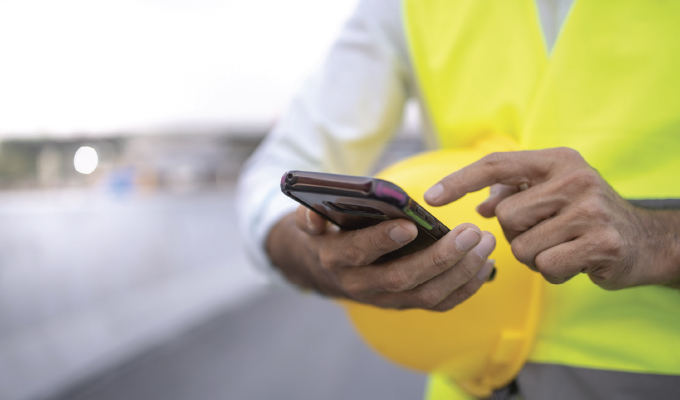
With the first iPhone released almost 20 years ago, smart devices have proven staying power as a force multiplier and significant convenience for construction professionals.
But smart devices also create many potential risks on jobsites, particularly with a virtual guarantee of an iPhone or Android in every worker’s pocket. While many companies have policies to ensure workers are not distracted or using devices in unsafe ways, these are only some of the most direct risks smart devices may carry.
In this article, we take a look at some additional considerations smart devices bring to the jobsite and some ways to mitigate those risks.
WORKSITE PHOTOS AND VIDEOS
Regular site photos and videos can be integral to a project file, providing a visual progress record, documenting work that may become hidden as the project continues, and vital to addressing issues related to jobsite safety.
The Risks: However, with every worker carrying a smartphone there are potentially hundreds to thousands of sources of “unofficial” jobsite photos and videos. While these are not inherently bad—a photo or video shows what it shows—they could create issues or confusion when there is a discrepancy between those reports and photos in the project file or what other sources might show. Project or site confidentiality could be another consideration, especially for government or propriety jobs.
Ideas to Mitigate Those Risks: Construction professionals should ensure they have policies and training in place for all workers, regardless of level, to understand any limitations on jobsite photos. Specific contract and subcontract provisions concerning what is permissible might also be worthwhile to ensure there is no ambiguity, particularly on jobs where confidentiality and nondisclosure are issues.
TEXTS, TEAMS, AND OTHER MESSAGING PLATFORMS
It is now simple to connect and communicate with anyone, anytime, from anywhere. Even large and complex documents can be instantly shared, and group-based messaging platforms promote around-the-world collaboration in ways that were considered science fiction not that long ago.
The Risks: While texts and messaging platforms have unquestionably changed the speed and efficiency in which we can communicate, they have also changed how we communicate. With communications with an owner or subcontractor as an example, a quick, friendly text might become an argument for a contract modification or waiver should a dispute arise. Even when a contract contains “no modification / no waiver” provisions, in many jurisdictions these can themselves be modified or waived by the parties’ “course of performance” in carrying out the contract.
Another potential risk lies in communications concerning worker injuries, OSHA concerns, and other types of legal matters. Unlike meetings, phone communications, or formal incident reports, text messages can be circumspect, spur-of-the-moment, come across as overly jovial, critical, or uncaring, or otherwise lacking important context.
Even email over smartphones can create issues as these can carry the appearance of more official communication, but may not truly be as well-developed, thought-out, or detailed. Additionally, while convenient, app-based email systems on smaller screens tend to increase the risk of inadvertently adding unintended recipients or a “reply all” when a smaller group was intended.
And perhaps most importantly, all of these are forms of written communication, meaning they could be discoverable in legal proceedings, may be shown to a judge or jury, and could even become part of the public record.
Ideas to Mitigate Those Risks: To address potential contract-related issues, one sound tactic is to have a well-thought out process for contract modifications and stick to it. If the contract requires any and all modifications through written change order, then follow the contract. While a quick “Sounds good!” or thumbs-up emoji may seem efficient in the moment, on the wrong subject matter these responses can prove costly and time-consuming ambiguities if a project dispute arises months or years later.
Developing policies, procedures, and training can also be a helpful mitigation tool. Limiting the use of messaging platforms for certain types of matters, like worker injuries, can help to ensure these communications come through more robust and appropriate channels, rather than text or group messaging platforms where there is a potential the communication is speculative, not yet developed, or may be missing context.
A.I. AND L.L.M. PLATFORMS
One of the benefits of the construction industry is that the work will (probably) not be replaced by a computer any time soon. Even though putting buildings up still requires hard work and human hands, there are numerous potential uses of Artificial Intelligence (A.I.) / Large Language Model (L.L.M.) platforms in the construction trade. Plus, since most major A.I. / L.L.M. platforms have a quick-to-download and easy-to-use app, there is a good chance A.I. is already on the jobsite whether recognized or not.
The Risks: A key consideration for almost all publicly available A.I. / L.L.M. platforms is that you may not own the data. That means if the information could be proprietary, confidential, or otherwise protected, it should most likely not be placed on a publicly available A.I. / L.L.M. platform that does not limit how the data is used.
Moreover, courts and lawmakers are still developing how and what law applies to these platforms, and to err on the side of caution, construction professionals should assume anything and everything submitted to an A.I./L.L.M. platform could be considered public information and might not have any protection whatsoever from discovery in legal proceedings.
Ideas to Mitigate Those Risks: Companies should have clear policies on what, if any, A.I. / L.L.M. platforms are appropriate for work-related use, who may use them, and what sort of information can be used.
DON’T LET UNLIMITED POTENTIAL MEAN UNLIMITED RISK
These are just a few of the many considerations smartphones can bring to the jobsite. With the possibility that every worker has a constantly connected, GPS-equipped, continuously recording device in their pocket, there are few limits to how these devices may hypothetically be used or come into play in a dispute.
Legal counsel can be helpful in thinking through these considerations and ensuring policies, procedures, employee training, and contracts have well-developed and appropriate measures to address these risks. And on those occasions where a contract dispute, worker injury, or other issue arises, counsel can be vital to identifying what other sources of information may be helpful or may need to be protected or safeguarded.
With first-generation iPhones now old enough to vote, smart devices have proven a long-term feature of everyday life. But if they are a feature of your jobsite, it is important to be smart about how these smart devices are used.
about the authors
Dixie T. Wells is a partner in the Greensboro, North Carolina, office of Ellis & Winters LLP. She represents clients in lawsuits involving engineering issues, higher education law, complex commercial transactions, and products liability. She is a member of the Construction Law and Litigation Committee of the International Association of Defense Counsel. She can be reached at dixie.wells@elliswinters.com. Chris Flurry is an attorney in the Raleigh, North Carolina, office of Ellis & Winters LLP. He focuses his practice on construction law and commercial contract disputes. A Marine Corps veteran and son of a brick mason, he is a member of the Associated Builders and Contractors of the Carolinas. He can be reached at chris.flurry@elliswinters.com.