

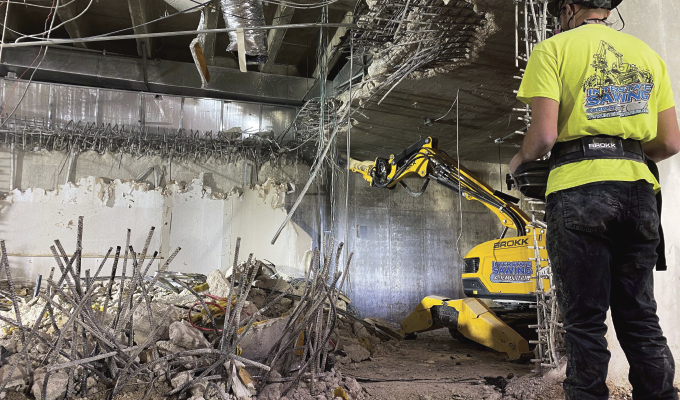
Efficiency is the name of the game in demolition. Contractors invest in highly productive equipment to keep projects on schedule. A lack of supporting machinery for the other aspects of the operation, such as cleanup, can tank the efficiency gained from using a demolition machine.
The cleanup process is an area where production can take a hit. Allocating manual labor to debris cleanup hurts the efficiency gained and makes it significantly more challenging to turn a profit. Technology has improved across the board, and it’s critical that the proper equipment is used both for demolition as well as the cleanup process. It’s all about the material and handling it as few times as possible.
Bob McCabe, regional manager for the Northeast U.S. at Brokk Inc., provides insight on how to properly execute this crucial process. McCabe has worked in the demolition industry since 1975, first as a laborer, followed by becoming an operating engineer, then a contractor and now as a regional sales manager. He recommends organizing the process into three main areas:
WORK AREA
In the work area, operators are running the demolition machine and removing material at a rate that rapidly creates a large amount of debris. Whether it’s interior or top-down demolition, a demolition machine is significantly more efficient than jackhammering or other manual methods. Multiple machines may be used throughout the project, depending on the scope of the work.
In the work area, the ideal setup to maximize efficiency starts by using one demolition machine with a breaker to make the debris and a second with a crusher attachment to separate the rebar and other material from the concrete. This results in clean, ready-to-sort concrete. Contractors can even make a little extra money by selling salvageable materials like wiring, copper, brass and aluminum that are separated from the concrete.
The work area is the first opportunity on a demolition job to implement efficient processes, and it’s critical to keep that momentum rolling into the next phase.
SORTING AREA
The sorting—or cleanup—area is where workers clear out all the debris left over from the work area. It can be the most challenging but important step to execute correctly. A demolition machine may complete demolition in a fraction of the time, but the crew loses the momentum gained from that productivity if the cleanup process is slow and outdated. Many operations assign this work to crew members with wheelbarrows. A manual process won’t be able to efficiently keep up with the amount of debris created, so the job should be mechanized to maximize productivity. It must be done properly with equipment like a skid steer, compact track loader or mini dumper. Taking advantage of those machines’ productivity will optimize efficiency in the cleanup process and maintain a well-run worksite.
Using the proper material-handling equipment provides far greater operator safety in addition to significant gains in efficiency. Workers are hard to come by in the first place, with a general labor shortage running rampant in the industry. If an employee is injured on the job, it may be hard to find another laborer, let alone one who is skilled, to fill the void.
“The labor shortage in general construction today is profound,” McCabe says. “Contractors have come to the realization in the last couple of years that they have to mechanize and streamline their operations if they want to survive and make money on the job.”
LOADOUT ZONE
Once debris is sorted and the second phase of the project is finished, the cleanup equipment hauls the material and other debris to the third and final stage of the project—the loadout area. This is where clean product is loaded onto a trailer or dump truck to be hauled away. Crews may use an excavator or similar equipment that provides more reach if loading material into something larger like a dump trailer. From there, concrete, metal, or any other materials are hauled to a processing plant to be recycled or discarded.
Using the correct method to separate materials (keeping concrete with concrete, drywall with drywall, etc.) and cleanup debris is critical in maintaining a profit because these materials from the jobsite are charged by the ton. Contractors will be charged far more when dropping off drywall debris for recycling if heavier concrete is mixed with lighter drywall rather than having one truckload of just drywall.
Ideally, there are no personnel on foot in the sorting or loadout areas. Everything in today’s demolition projects should be accomplished with equipment like a skid steer or loader. From a safety point of view, operations don’t want laborers in the way of machinery and potentially in harm’s way. Mechanizing the entire jobsite keeps productivity high and injury risk low.
PRODUCTIVE FROM START TO FINISH
It’s important to implement highly efficient processes from the beginning of demolition to the time material leaves the worksite to be a successful demolition contractor.
“Overlooking the cleanup aspect and deploying manual methods can bring contractors to a screeching halt,” McCabe says. “You need a steady, safe operation from the lead demolition machine creating debris until the material drives away from the jobsite. This is what is going to make a demolition contractor successful or put them out of business.”
about the author
Jeff Keeling is vice president of sales and marketing for Brokk Inc., which has been the world’s leading manufacturer of electric remote-controlled demolition machines and attachments for 50 years. For more, visit www.brokk.com.