

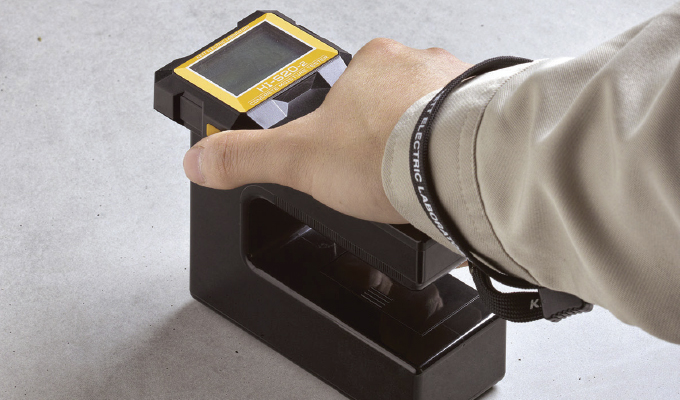
Concrete construction depends on accurate moisture monitoring during curing and every stage that follows. The quality of cast-in-place concrete depends on accurate moisture measurement.
Moisture meters are used during the curing process to monitor how quickly moisture is being lost from the slab. These readings guide critical decisions on curing duration, when to re-wet the concrete, and timing for applying sealers or coverings.
By tracking moisture levels, project teams can avoid premature drying that causes surface cracking and dusting. Excess moisture can also be a problem, becoming trapped beneath impermeable coatings and leading to blistering, delamination, or microbial growth.
In many cases, however, pouring and curing concrete is only the first step in the construction process. At each stage, properly assessing moisture levels is essential because flooring systems, surface coatings, drywall, and other finishing materials depend on controlled moisture conditions to perform as expected.
As a result, contractors require a moisture meter that delivers rapid readings, is easy to carry from area to area, and provides dependable accuracy on every check. Ideally, one device should cover the full range of moisture-measurement needs, allowing crews to stay productive and achieve consistent, reliable results throughout the entire project.
Although moisture meters have been available to the construction industry, many models require calibration, sample collection, and extended processing time. They also often lack the portability and ruggedness required for reliable use in field conditions.
Fortunately, more advanced, handheld, instant moisture-measurement devices are now available that allow contractors to spot check concrete and other materials without specialized training.
ONE METER FOR ALL STAGES
Moisture measurement is required at specific stages of a concrete project beyond the first pour. During the first 24 to 48 hours, readings are taken to confirm that moisture content targets are being met. These early measurements allow crews to adjust how often they wet the concrete.
As curing continues through the first week, follow-up readings track moisture loss and determine when curing can be reduced or stopped. Moisture must be checked again before applying sealers, membranes, or floor coverings to ensure residual moisture is not trapped beneath finishing materials, which can cause adhesion failures and long-term performance issues.
“It is important to remember that curing concrete is a precise science. Factors such as rain, humidity, groundwater, temperature, and air circulation can all affect the moisture content in concrete and mortar,” says John Bogart, managing director of Kett US, a manufacturer of a full range of moisture and organic composition analyzers.
“If moisture levels are not carefully monitored, small fluctuations can become major costs,” he adds.
Once the concrete has been set and cured, site crews must consider the next steps, including the actual building of a structure, and essential steps like waterproofing, interior finishing, and painting. These steps require precision and accuracy just like during the concrete pouring and curing processes.
Industry innovators like Kett US have developed a simplified approach with testing equipment that allows anyone in the field to get laboratory-quality measurements in any environment.
EASY OPERATION
“Using a handheld device such as the HI520-02 moisture meter, the worker will select the calibration [i.e.-concrete or mortar], press it against the sample, and moisture is immediately displayed with accuracy of +/-0.5 percent,” says Bogart.
Automatic temperature compensation enhances measurement accuracy, and two “raw” modes allow the user to calibrate for deep or shallow samples. Up to 1,000 measurements can be stored in memory and downloaded to a PC for analysis.
The meter allows contractors to test a wide range of materials using pre-set or personalized calibrations, all with a single laboratory-quality instrument. This battery-powered handheld instrument delivers portable moisture readings across drywall, mortar, gypsum, interior finishing materials, waterproofing systems, paints, and related applications. With fast, high-accuracy measurements and support for more than a dozen material calibrations, the meter eliminates the need for construction crews to transport multiple meters to the jobsite.
By supporting consistent moisture measurement from initial curing to final finishes, this meter removes uncertainty in every phase of the build. Crews can rely on one instrument to maintain control over moisture conditions and make informed decisions throughout the entire construction process.
“This single, portable instrument consolidates the functions of many, keeping moisture checks fast and straightforward on the job site,” adds Bogart.
for more information
For more, visit www.kett.com or call 800.438.5388.