

Y
ou know your company can handle a bigger job. You have the crew, equipment, and experience. Then you talk to your bonding agent and find out capacity isn’t where you thought it was or where it should be.
That disconnect is more common than contractors think. Many times, the problem isn’t whether you can do the work. It’s whether your financials give the surety enough confidence to let you do it.
Sureties want to know you can fund the job, handle a setback, carry payroll when an owner is slow to pay and still finish what you started. If your numbers don’t tell that story, your bonding capacity can get squeezed even when the company is strong.
Before assuming you’ve hit your ceiling, take a hard look at these seven areas.
1. Your working capital looks better than it really is.
The working capital on your balance sheet isn’t always what the surety sees.
You may have a healthy accounts receivable balance, but how much of it is 90 or 120 days old? Maybe you have money due from a related company. Your surety may not give it full value. The same goes for prepaid expenses or assets that aren’t going to help you make payroll next Friday.
That’s the real question: How much money is truly available to run the business?
Before asking for more bonding, clean up old receivables, watch distributions, and make sure the balance sheet reflects the liquidity you truly have.
2. Nobody trusts the WIP schedule.
Your WIP (Work In Progress) schedule is the best tool you have for staying on top of how jobs are really performing, but I’ve seen plenty treated like homework somebody has to finish for the CPA at year-end.
Your WIP Schedule tells the surety whether jobs are performing the way you said they would. If costs-to-complete are stale or margins jump around without explanation, project managers and accounting can end up with completely different versions of how a job is going.
You don’t need a perfect WIP Schedule. Construction isn’t perfect. But you do need one that makes sense.
Review it monthly. Get accounting and operations in the same room and on the same page. If a margin dropped three points, know why. If a job is 80 percent complete but barely billed, know why.
Don’t make your surety figure out your job performance for you.
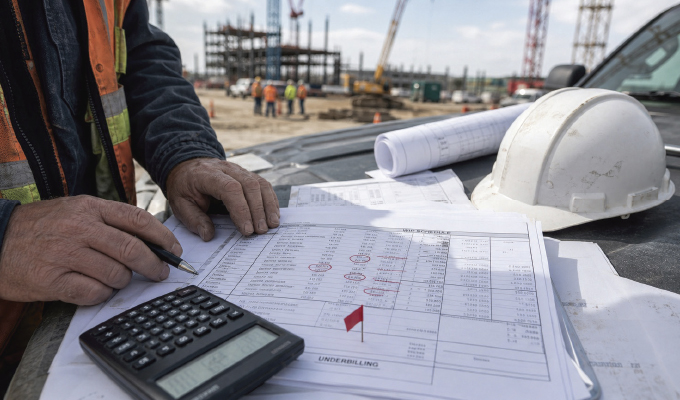
3. Underbillings keep showing up.
Underbillings aren’t automatically bad. Timing, billing requirements, and pending change orders can all create legitimate ones, but large or chronic underbillings, especially late in a project, can get a surety’s attention quickly.
The National Association of Surety Bond Producers (NASBP) published an example where underbillings overstated a contractor’s working capital by nearly $3 million. Some were tied to jobs that were almost finished and already losing money.
That’s when underbilling starts looking less like timing and more like money that may never be collected.
Ask why it exists. Is it collectible? Are change orders approved? Is the estimate to complete still realistic?
4. Your job costing can’t keep up with the field.
A company can be profitable and still make a surety nervous if nobody can explain which jobs are making money.
Your project manager says the job is making 12 percent. Accounting says 8 percent. The estimator is still working off the original budget. Which number should the surety believe?
Costs should be coded consistently and change orders reflected promptly. Your surety wants evidence that you know where a job stands today, not where it stood three months ago.
5. Your financial statements haven’t kept up with the company.
This one sneaks up on contractors. You start small, and internally prepared financials are fine. Then revenues grow, and you’re chasing jobs three or four times the size of what you used to do, but the financial reporting never changed.
As bonding needs increase, the surety may want CPA-prepared statements and, depending on the program, a compilation, review, or audit.
You don’t want to learn that when a bid is due in two weeks.
Ask your bonding agent what they’ll want to see if you increase your single-job limit or aggregate program. Then talk with your CPA about what needs to change. Your financial reporting should support the company you’re becoming, not the one you were five years ago.
6. Your backlog is growing faster than the company.
Backlog feels good—until it doesn’t.
Winning $30 million of work doesn’t automatically mean you’re ready to carry $30 million of work.
Every new project needs cash before it produces cash. Payroll hits. Materials show up. Subs want to get paid. Retainage piles up. Then, an owner pays late and suddenly a company that looks great on paper is stretched thin.
That’s why sureties look at more than backlog. They want to know whether you have the financial and management capacity to carry it.
Look at when large projects overlap, what cash needs will look like at peak production, and whether you have enough project management depth.
Sometimes the smartest growth decision is knowing when one more job is one job too many.
7. You don’t have a strong banking relationship or line of credit.
The worst time to establish a line of credit is when you desperately need one. NASBP identifies a strong banking relationship and access to credit as important parts of a contractor’s bonding picture. Construction companies routinely fund payroll, materials, and insurance long before the owner pays.
Meet with your banker before you need the money. Make sure the line still fits the size of the company, understand the covenants, and know what it takes to increase it.
YOUR FINANCIALS MAY BE HOLDING YOU BACK
Bonding capacity isn’t just a judgment about whether you’re a good contractor. It’s about how much risk your financials show the company can handle. And those numbers are built all year long.
Every time you update the WIP Schedule, revise a cost-to-complete estimate, collect a receivable, take a distribution, or talk with the bank, you’re adding to that story.
The goal isn’t to make the numbers look better for the surety. It’s to make sure they accurately show the strength of the business.
If you have the people, experience, and operational capacity to take on larger work but your bonding program isn’t growing with you, don’t automatically assume you’ve hit your ceiling.
You may have more bonding capacity than you think. Your financials just have to prove it.

about the author
Charlie Holleman, CPA, is audit partner at PriceKubecka and a member of CFMA and AGC. He works closely with contractors on financial reporting, WIP discipline, and accounting processes that can affect bonding capacity and banking relationships. PriceKubecka is a Texas-based CPA firm with 30 years of experience serving general contractors, heavy highway contractors, specialty contractors, and architecture and engineering firms across the country.